

By Olendo Simon Okola
The coming El Niño is not only a weather emergency. It is a test of whether Africa can move climate finance from reacting to disasters to investing before losses occur.
Africa has received the warning. The next question is whether the money will move before the rivers rise, crops are destroyed, roads become impassable and communities are displaced, or whether finance will once again arrive after the damage has already been done.
That question has become urgent. The World Meteorological Organization confirmed on 3 September 2026 that El Niño is firmly established and expected to intensify into a very strong event, with a near-100 per cent likelihood that it will persist through February 2027.
A week later, the US National Oceanic and Atmospheric Administration went further: its Climate Prediction Center now estimates a greater than 90 per cent probability of a very strong El Niño during the Northern Hemisphere autumn and winter of 2026–27. NOAA also gives a 75 per cent chance that the October to December 2026 event could reach a strength exceeding previous El Niño events in its record dating to 1950.
Those are extraordinary numbers. But a strong El Niño does not automatically mean catastrophe everywhere.
The World Meteorological Organization cautions that the severity of local impacts depends on geography, season and other climate drivers, including conditions in the Indian and Atlantic Oceans.
That distinction matters: preparedness must be based on regional and national forecasts, not simply on the label “El Niño.”
What is already clear, however, is that large parts of Africa are entering a period of elevated climate risk.
One El Niño, two African realities
The continent could experience two contrasting climate emergencies at the same time. For the Greater Horn of Africa, the IGAD Climate Prediction and Applications Centre is forecasting an increased likelihood of wetter-than-normal conditions during the October–December 2026 season.
The forecast is particularly striking in southern Ethiopia, central and southern Somalia and north-eastern Kenya, where ICPAC places the probability of enhanced rainfall at 90 per cent.
It also identifies a high probability of seasonal rainfall exceeding 400 millimetres in parts of central Kenya, the Lake Victoria Basin, central and southern Somalia, Burundi, western Rwanda and western Tanzania. In parts of Ethiopia, Kenya and Somalia, the October–December season can account for as much as 70 per cent of annual rainfall.
For western Kenya and the Lake Victoria Basin, this deserves close attention. Rain is not inherently a disaster. Good rains can increase agricultural production, replenish groundwater, restore pasture, improve hydropower prospects and increase water availability.
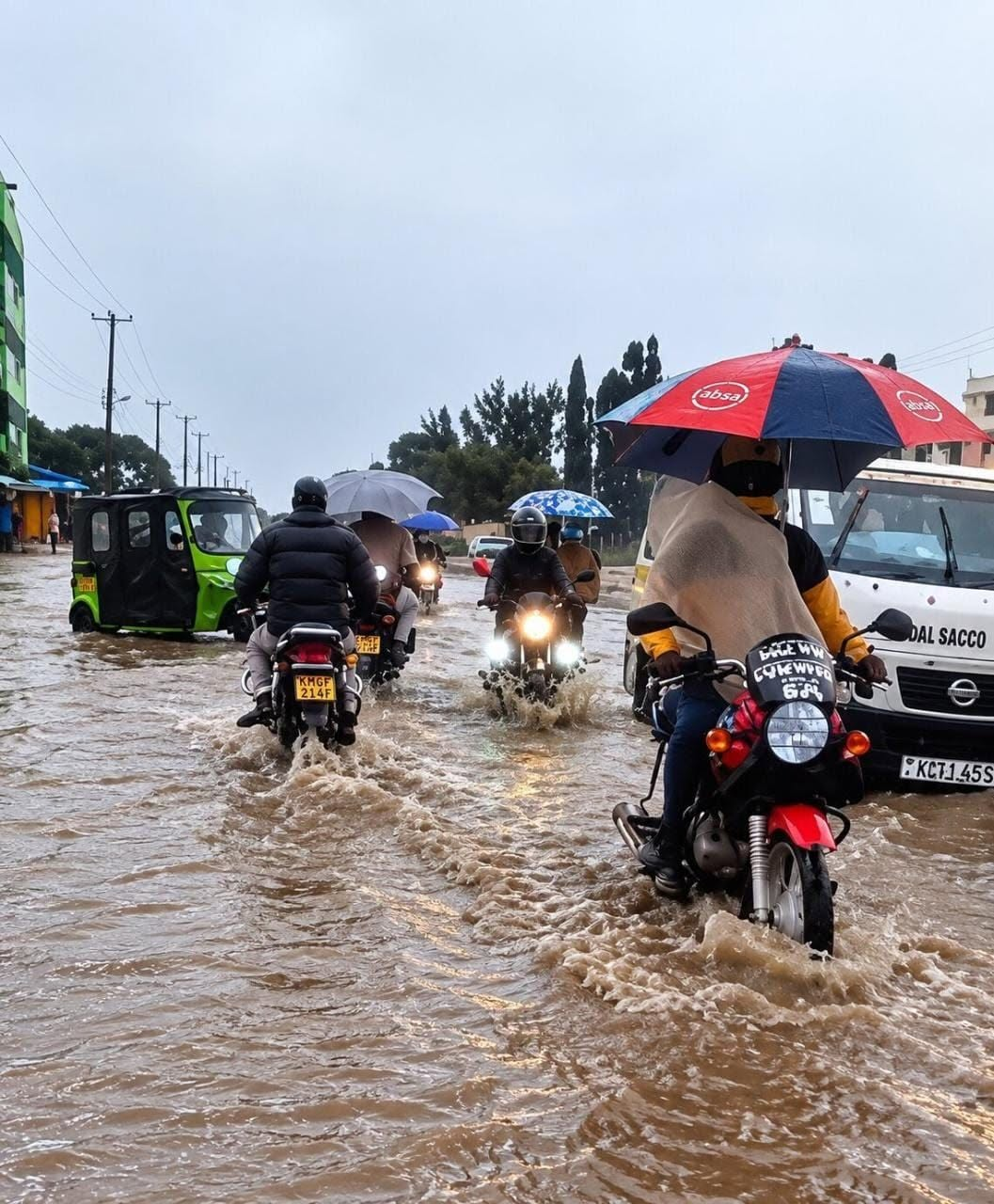
The danger arises when rainfall intensity overwhelms drainage systems, degraded watersheds, roads, farms, settlements and other vulnerable infrastructure.
Meanwhile, Southern Africa faces almost the opposite risk. The Southern African Development Community’s 2026/27 seasonal outlook favours below-normal rainfall across much of Angola, southern Zambia, Zimbabwe, Mozambique, Namibia, Botswana, most of South Africa, Eswatini and Lesotho during October–December 2026.
Drier conditions are expected to persist into early 2027 across large parts of the region, while above-average temperatures are favoured across most of SADC. Africa could therefore be responding simultaneously to flood risk in the east and drought and heat stress in the south.
This is much more than a weather story. It is a food-security issue, a public-health issue, an infrastructure issue, a fiscal issue—and fundamentally, a climate-finance issue.
Kenya already knows how expensive climate shocks can become. There is a dangerous tendency to regard climate preparedness as an additional cost government must somehow accommodate. The evidence suggests the opposite. Failure to prepare is itself extremely expensive.
Kenya’s Second Nationally Determined Contribution states that climate change and extreme weather are estimated to erode 3–5 per cent of the country’s GDP annually.
In 2023 alone, drought caused estimated direct losses of more than US$650 million. This was followed by the 2024 floods, which caused direct losses estimated at more than US$1.46 billion. Together, the two shocks amounted to roughly 2 per cent of GDP.
The agricultural impact of the 2024 floods illustrates the exposure even more clearly. A government-led recovery assessment estimated approximately KSh34.9 billion in agricultural damage and KSh84.8 billion in production losses.
This matters because Kenya remains highly dependent on climate-sensitive sectors. Agriculture and livestock contributed about 21.2 per cent of GDP in 2022, while smallholder farmers produced approximately 80 per cent of the country’s agricultural output, according to Kenya’s NDC.
When climate shocks hit agriculture, therefore, the consequences do not remain on farms. They move rapidly into food prices, household incomes, employment, manufacturing, public expenditure, trade and poverty.
This is why the coming El Niño should be discussed not only by meteorologists and disaster-response agencies. Finance ministries, county governments, banks, insurers, investors, development partners and climate funds should also be at the table.
Africa’s problem is not only a finance gap
There is another problem that receives far less attention. I call it the forecast-to-finance gap. We are becoming considerably better at predicting climate hazards.
What remains weak is our ability to convert those forecasts into timely financing decisions before losses occur. Think about the conventional disaster-financing cycle.
A flood occurs, damage is assessed, government declares an emergency, humanitarian agencies mobilise, development partners pledge money, recovery plans are prepared. Infrastructure is reconstructed.
In effect, enormous amounts of money are mobilised after assets, businesses and livelihoods have already been destroyed.
The more intelligent sequence would be: forecast → risk identification → finance trigger → anticipatory investment → avoided losses.
That is the transition Africa urgently needs. And the economics support it.
The World Meteorological Organization reports that providing just 24 hours of warning before an impending hazardous event can reduce resulting damage by approximately 30 per cent. Multi-hazard early-warning systems are estimated to generate approximately US$9 in net economic benefits for every US$1 invested. An investment of US$800 million in early-warning systems in developing countries could avoid between US$3 billion and US$16 billion in losses annually.
But forecasting alone is not enough. An early warning that does not trigger financing, evacuation, water storage, drainage clearing, crop protection, insurance payouts or emergency preparedness is simply information.
Early warning becomes climate resilience only when somebody has the authority, resources and financing mechanism to act on it.
The adaptation-finance gap makes this harder
Unfortunately, adaptation remains dramatically underfinanced.
UNEP’s Adaptation Gap Report 2025 estimates that developing countries will require between US$310 billion and US$365 billion every year by 2035 for adaptation. International public adaptation finance to developing countries was only US$26 billion in 2023.
That means estimated adaptation needs are approximately 12 to 14 times current international public flows.
Africa’s position is similarly sobering. Climate Policy Initiative estimates that climate-finance flows to Africa averaged about US$43.7 billion in 2021/22, while only about 23 per cent of the continent’s estimated annual climate-finance needs were being met.
Private finance accounted for just US$8 billion, or approximately 18 per cent of total climate-finance flows.
These figures reveal an important truth. Africa does not only have a shortage of climate finance. It also has a readiness, project-preparation and bankability challenge.
Funding rarely moves simply because a community is vulnerable or because an intervention is environmentally desirable.
Financiers need credible projects.
They need clearly defined climate risks, technically feasible interventions, competent implementing institutions, credible budgets, financial models, environmental and social safeguards, measurable results, monitoring systems, governance arrangements and realistic sustainability strategies.
This creates a cruel paradox: some of the communities facing the greatest climate risks may also have the weakest capacity to package those risks into projects capable of attracting finance. Closing that gap should become part of adaptation policy itself.
Kenya’s own climate-finance numbers make the point
Kenya’s Second NDC estimates that approximately US$56 billion will be required for mitigation and adaptation actions between 2031 and 2035. Of this, around US$17.7 billion is specifically required for adaptation. Kenya expects to mobilise about 19 per cent of the overall NDC financing domestically, leaving approximately US$45.36 billion, or 81 per cent, to depend on international support.
The implication is profound. Kenya will not secure US$45 billion merely by demonstrating that climate change is serious. It will have to develop a large pipeline of credible, investment-ready and fundable projects.
The same applies across Africa. This is where climate-finance readiness becomes as important as climate-finance availability.
So what should finance before El Niño look like? The immediate priority should not be one giant “El Niño project.”
It should be a portfolio of locally targeted investments. In flood-prone locations, financing should support drainage rehabilitation, catchment restoration, wetland protection, climate-resilient roads, river monitoring, water infrastructure and settlement preparedness.
For farmers, funding should enable climate information services, improved seed varieties, water harvesting, soil conservation, disease surveillance, crop and livestock insurance, post-harvest storage and rapid access to working capital after shocks.
For drought-exposed regions, the priority should include water storage, groundwater systems, drought-tolerant crops, livestock protection, index insurance, strategic fodder reserves and efficient irrigation.
And at the institutional level, county governments, community organisations, cooperatives and MSMEs need something less visible but equally important: project-preparation capacity. A community may understand perfectly which river floods every year.
A county government may know exactly which drainage system requires rehabilitation. A farmers’ cooperative may understand its water problem better than any outside consultant. But knowledge of a problem is not the same as having a finance-ready project. This is the missing bridge.
Climate finance must move closer to where climate risk occurs
The coming months also raise a deeper issue about the architecture of climate finance. Too much climate finance remains centralised, slow and administratively demanding. Yet climate impacts are intensely local. They occur on a farm in Homa Bay. At a flooded market in Kisumu. Along a riverbank in Budalangi. At a drying borehole in southern Africa. Inside a small business whose supply chain has collapsed.
National governments and international institutions remain indispensable, but locally led climate action will remain rhetoric unless local institutions can access meaningful resources and build the systems required to manage them. This means strengthening county-level climate-finance pipelines, supporting community institutions to meet fiduciary and safeguard requirements, financing project preparation, improving climate-data systems and developing financing vehicles capable of aggregating many small resilience investments.
It also means expanding pre-arranged finance. Contingency funds, forecast-based financing, insurance, concessional credit, guarantees, grants and blended-finance instruments should increasingly be designed so that agreed climate thresholds can trigger action before an emergency becomes a catastrophe.
El Niño is therefore a governance test
For me, the central question raised by the 2026–27 El Niño is not whether Africa has enough climate information.
We increasingly do. We have satellite observations. We have sophisticated climate models. We have seasonal forecasts. We know vulnerable sectors. We know many vulnerable locations.
And we know many of the interventions that can reduce losses. The harder question is whether our financing and institutional systems can move at the speed of climate risk.
If we receive a credible warning months in advance but wait until communities are under water before resources are released, the failure is no longer simply meteorological. It is institutional. It is financial. It is a failure of preparedness.
Africa must therefore move climate finance beyond the traditional model of financing recovery from yesterday’s disaster towards financing resilience against tomorrow’s known risks.
The 2026–27 El Niño gives governments, climate funds, development banks, insurers, private investors and local institutions an opportunity to demonstrate that this transition is possible.
Because in climate finance, one of the greatest returns on investment is not necessarily something we build.
Sometimes it is the loss that never occurs, the crop that is not destroyed, the business that does not close, the family that does not have to leave its home, and the disaster that never becomes a humanitarian emergency.
Africa has received the forecast.
Now the real test is whether the finance will move before the disaster does.
About the Author
Olendo Simon Okola is a climate-finance consultant and Founder & Lead Consultant at Agenda Beyond Borders (ABB).