

By Paul Saoke
The significance of the Dangote Lamu refinery is not merely that it may alter the balance of economic power between regions. Its deeper significance is that it could contribute to the democratisation of Kenya’s economy by widening the geographical and social distribution of productive opportunity.
The article argues that the proposed refinery could challenge the long-established perception of Mt Kenya as Kenya’s dominant economic powerhouse and create space for new economic centres. (Western Insight) That is an important observation. But the more consequential question is what happens when economic growth ceases to be concentrated around a relatively small number of established commercial centres.
The real issue is economic democratisation
For decades, Kenya’s economic geography has been characterised by considerable concentration. Capital, infrastructure, financial institutions, industrial capacity, markets and business networks have tended to reinforce one another in a limited number of regions. This produces a powerful economic feedback loop: areas that already possess capital and infrastructure attract more investment, while areas with less capital and infrastructure struggle to catch up.
The Lamu refinery has the potential to disrupt that pattern.
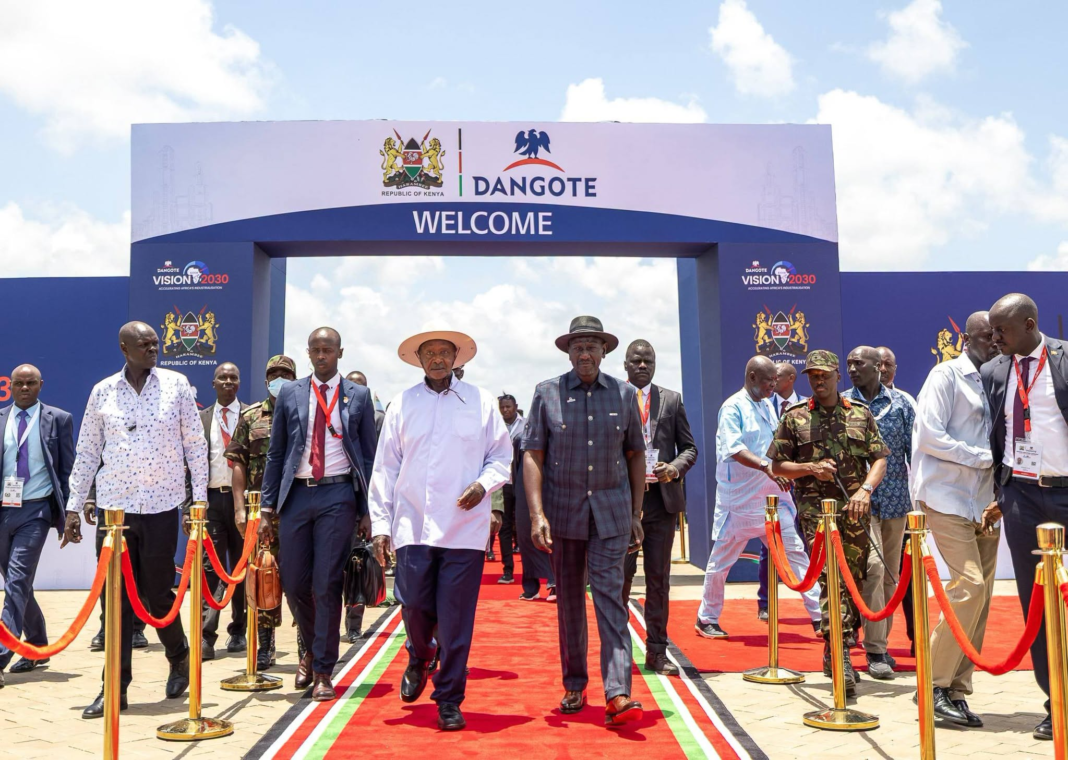
At an announced investment of approximately US$16 billion, with a planned processing capacity of 700,000 barrels of crude oil per day, the project is of a scale capable of creating an entirely new industrial ecosystem rather than simply adding another enterprise to an existing one. The wider complex is expected to include power generation and petrochemical manufacturing, while government sources anticipate substantial employment and opportunities for Kenyan suppliers. (ICT Authority)
That distinction is crucial.
Economic development is not democratised merely because a large project is constructed in a previously marginalised region. It becomes democratised when the project creates pathways through which ordinary citizens, local enterprises, workers, professionals, young people and communities can acquire productive assets, skills, contracts, incomes and ownership.
That is the opportunity before Kenya.
From regional concentration to multiple economic centres
The most important consequence of the Lamu investment could therefore be the emergence of a more polycentric Kenyan economy.
Lamu can become an industrial and logistics centre. The Coast can deepen its maritime economy. Turkana can participate more substantially in the petroleum value chain. Nyanza and western Kenya can supply skills, agricultural products, services and manufactured inputs. The northern counties can participate in logistics and regional trade. Existing industrial centres need not lose their importance; rather, new centres can emerge alongside them.
Indeed, government statements describe the Lamu project as an anchor for energy, manufacturing, transport, logistics and related industries along the LAPSSET corridor. (Ministry of Foreign Affairs)
This is what makes the project potentially transformative.
A corridor without productive economic activity at its nodes remains primarily transport infrastructure. An industrial anchor can turn roads, ports, pipelines, railways, power infrastructure and telecommunications into instruments of production.
The question, therefore, should not be whether Lamu will replace Mt Kenya.
It should be whether Kenya can move from an economy in which opportunity is heavily concentrated to one in which many regions have the capacity to generate wealth.
Democratising opportunity, not redistributing resentment
There is an important distinction here.
Economic democratisation should not mean transferring economic privilege from one region to another. It should mean expanding the number of regions, enterprises and citizens