Home Blog Page 213

Kenya has had significant diplomatic milestones in its 60 years of diplomacy says Mudavadi

0
Mudavadi Kenya foreign policy

By OPCS Press Service

26th November 2024, Nairobi

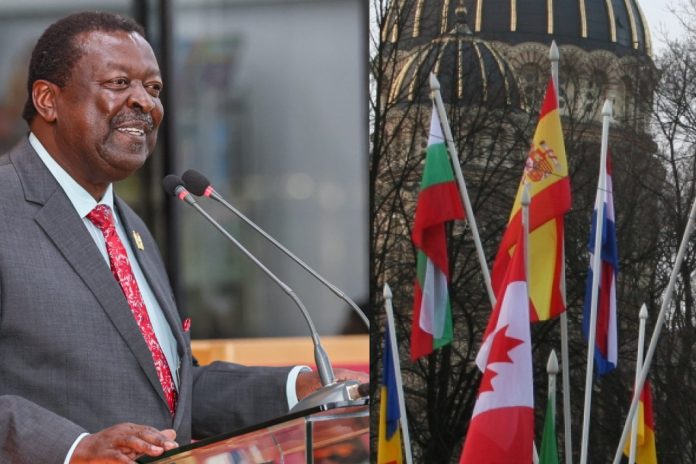
The Prime Cabinet Secretary has said that for six decades, Kenya has been at the forefront of diplomacy, advocating for mutual respect, dialogue, and unity on the global stage to benefit Kenyan citizens as it undertakes its role as a global citizen.

Speaking during the press briefing on 60 years of Kenya’s diplomatic journey, held at the Ministry of Foreign Affairs headquarters, Mudavadi noted that, over the years, the country has risen from a humble beginning—with just four embassies in 1963—to 68 missions spread across the world, championing the country’s interests.

“In its growth over the years, Kenya has emerged as a serious player in peace, participating in 43 peacekeeping and peace support missions, including to Yugoslavia, Cambodia, Iran, East Timor, Western Sahara, Sierra Leone, Liberia, the Democratic Republic of Congo, Somalia, South Sudan, and Haiti. This demonstrates our commitment to regional and global stability,” said Mudavadi.

He explained that these missions comprise 29 in Africa, 16 in Asia/Middle East, 14 in Europe, five in the Americas, and one in Oceania. “This diplomatic footprint also includes our offices in the United Nations capitals of Nairobi, New York, Geneva, and Paris,” said the Prime Cabinet Secretary, who is also the Cabinet Secretary for Foreign and Diaspora Affairs.

Mudavadi said that Kenya looks ahead with confidence to the next 60 years of its diplomatic journey, anchored on the country’s new foreign policy, which has been subjected to extensive stakeholder engagement in the past few weeks.

He noted that, as one of the founding members of the Organisation of African Unity, now the African Union, Kenya continues to champion African unity, economic integration, and peace.

Mudavadi highlighted Kenya’s achievements, including being the only country in the Global South to host a United Nations office and being elected to the United Nations Security Council (UNSC) in 2021 for a third term—justifying its capacity to shape global governance and advance Africa’s voice in multilateral diplomacy. “We do not take this for granted,” he added.

He also emphasised Kenya’s pivotal role as the global environment capital since 1972, when it hosted the United Nations Environment Programme (UNEP) global headquarters.

“Today, Nairobi is home to one of the largest UN duty stations, hosting approximately 20,000 staff operating under the umbrella of the United Nations Office in Nairobi. This population of UN staff is set to increase in 2025 as many staff relocate to Nairobi as part of the UN’s greater reform plans,” said Mudavadi.

The Prime Cabinet Secretary noted that the UN had significantly invested in the country. “As a nation, we will soon have a venue that can host a United Nations General Assembly—a transformative milestone for Kenya.”

“You will recall that Kenya hosted historic events such as the Third World Conference on Women (1985), the United Nations Environment Assembly (2021), and the inaugural Africa Climate Summit (2023). These and many others have solidified the country’s position as a global hub for diplomacy, international trade, and investment,” he said.

He announced that this December, the Ministry of Foreign and Diaspora Affairs will mark the 60th anniversary of Kenya’s diplomatic journey. “This will be a commemoration of Kenya’s enduring legacy in peacekeeping, regional leadership, and global diplomacy over these six decades. The celebrations will run from 27 November to 7 December 2024 and will feature a series of activities,” he said.

Outlining the events, he stated that the Ministry will hold its inaugural Open Day on 29 November 2024 at the Ministry Headquarters Car Park, inviting members of the public to learn more about the services offered.

Various conferences on diplomacy and foreign policy are planned for the following week, with President William Ruto, the “Diplomat Number One,” presiding over these events.

“There will also be exhibitions open to the public where various partners and organisations will showcase the services they have rendered to the country over the past 60 years. These exhibitions will be a great learning opportunity for those of us who believe that Kenya is not an island. I am sure there will be plenty of knowledge-sharing and excitement,” Mudavadi said.

Principal Secretary Korir Sing’Oei of the State Department for Foreign Affairs noted that the public events would offer an opportunity to understand the scope of diplomacy as practised by foreign service officers.

“They will also enable the public to appreciate the role citizens play in articulating the country’s foreign policy. Furthermore, these events will provide a great opportunity for interactions between citizens and the various practitioners of diplomacy,” said Sing’Oei.

The pain of Raila’s visit to a village for Wanga’s prayer to a university don

0
damages

By Investigative Team

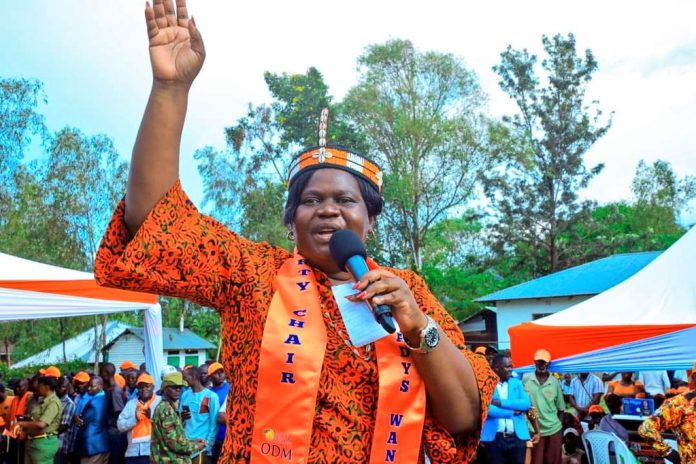
A university don bore the full brunt of the thanksgiving prayer for Orange Democratic Movement (ODM) National Chairperson Gladys Wanga at Ligisa Secondary School in Kochia, Homa Bay County.

Wanga, who is the Governor of Homa Bay County, hails from Kochia village, a few kilometres away from the Jaramogi Oginga Odinga University don’s home.

Professor G.Z.O. Nyotumba claimed that the Homa Bay County Government decided to open a new route to be used by Raila Odinga and other guests during the thanksgiving prayers for Wanga after she was appointed the party chairperson.

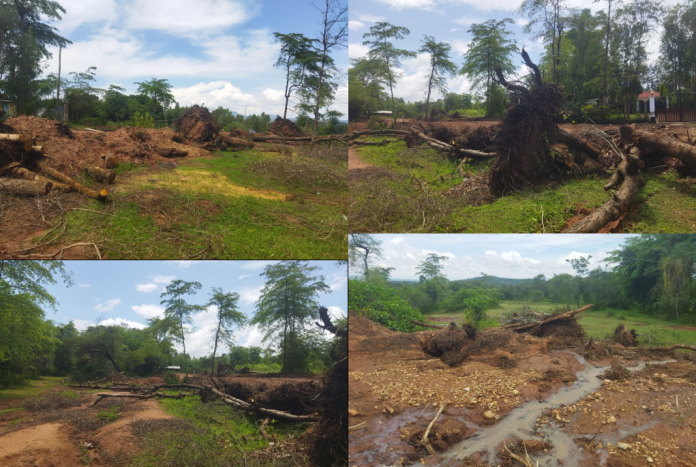
In a message shared in the Lake Land Development WhatsApp group, Nyotumba lamented and described the action by the governor and her administration as cruel and inhuman. “This is the damage that was done to my land in Kochia by Gladys Wanga in an operation personally supervised by Bernard Nyobange and a surveyor called Byron from Homa Bay County Government”. They said they were clearing the way for Raila to attend Gladys’ homecoming at Ligisa School.

The land was ringed by a 10-foot 6mm angle line pillared fence with heavy-duty chain link reinforced with barbed wire. While for most of the stretch from the junction of Nyagoro Chief’s Camp/Owili Ongei Homestead, the 6-metre provision was maintained, when her bulldozers and graders reached my parcel, they left neighbours’ fences intact and moved it to my fence 11 metres,”** Nyotumba alleged.

Attempts to contact Governor Wanga and the County Chief Officer for Public Communication, Ms Atieno Otieno, bore no fruit, as they did not respond to texts or phone calls. Similarly, we were unable to obtain a comment from Nyobange, as he did not reply to our texts.

Members of the WhatsApp platform expressed disappointment, with some claiming the issue could stem from long-standing differences between the parties involved, requiring a quick solution to prevent further escalation.

Others urged the don to seek legal redress for damages and compensation. “I don’t think we should be spectators. The best advice you should give him is to report the matter to the police. I am glad that he has documented the violations. Any civilised community should not tolerate such inhumanity,” wrote Onyango Odak, a diaspora-based Kenyan in the United States of America.

Homa Bay Governor Gladys Wanga has said she made the changes in the executive and the assembly to prevent infighting in her government.

0
Gladys Wanga

By Reporter

Wanga appointed the immediate former County Executive Committee (CEC) member for Trade, Tourism, Industry, Cooperative Development and Marketing, Mr Polycarp Okombo, to the post of Speaker of the Assembly.

She then nominated the immediate former Speaker, Julius Gaya, who resigned to create space, to the CEC post that Okombo previously occupied.

Gaya was forced to resign after 53 members of the County Assembly had appended their signatures to impeach him.

Wanga, who spoke in Homa Bay, said, “The government is one, and the changes were good for the county. Gaya, who is a strong party member, will now join me at the executive.”

Residents have expressed concern about whether the assembly will be able to execute its mandate of overseeing the executive, now that the Governor has effectively muzzled it.

They worry that the assembly could become a rubber-stamping institution with no teeth to bite or power to police the executive.

Wanga has already forwarded the list of nominees to the assembly, which will vet them.

With Wanga’s declaration of the changes, it appears it will just be a formality before Gaya is sworn in as CEC.

Okombo won the Speaker seat with a majority, beating his three opponents. Both Okombo and Gaya hail from the Central Ward in the Karachuonyo constituency.

The Speaker position had initially attracted 13 applicants; however, only four were shortlisted for the final exercise. The four were shortlisted after returning their nomination application forms on time.

Gaya succeeded the former Speaker, Elizabeth See, who was elected as Speaker after defeating her arch-rival, the former Gwassi North MCA, Evance Marieba, garnering 40 votes out of a possible 54.

WHAT EXACTLY DO KENYANS WANT RAILA TO DO?

0
Raila Odinga

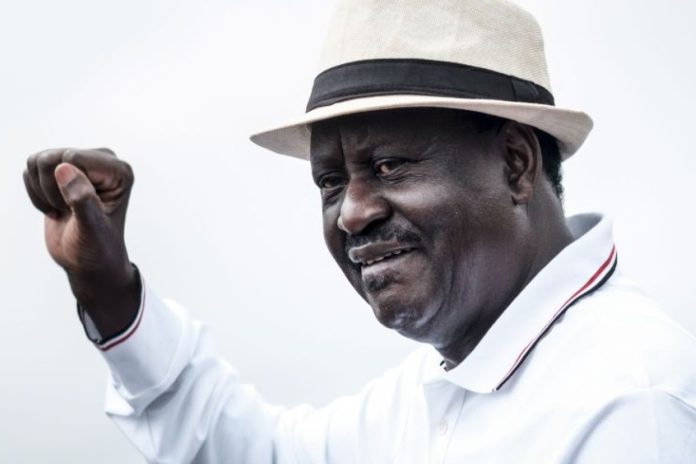
Raila Odinga’s name is synonymous with the fight for liberation, and several failed stabs at the presidency. For these, and many more reasons, the second-born son of Jaramogi Oginga Odinga, independent Kenya’s first Vice President, is loved and hated in equal measure. It was the late Vice President, Wamalwa Kijana, who once said that those who hated Raila did so with passion. Likewise, those who loved Raila were prepared to die for him. So, Raila is, indeed, an enigma. Raila’s public life is akin to the proverbial elephant that was experienced by six blind men. Each of the men attempted to describe the elephant depending on the parts of the gigantic animal that they touched. At the end of the day, none of the blind men had a holistic impression of the entire elephant. In Kenya’s political context, Raila Amolo Odinga is that elephant. The former Prime Minister has captured the imagination of Kenyans for several decades, yet nobody seems to truly capture the holistic nature of this enigma. First, Kenyans across the length and breadth of the country love to have him around. They truly cherish listening to him. But, for some strange reason, the very people who view him as their saviour from the excesses of the executive, do not want to make him their President. On several occasions, he has lost the presidency with a whisker. Pundits opine that there have been instances when his win was grabbed from him by the barrel of the gun. The most obvious one was the 2007 presidential poll which insiders intimate President Kibaki lost by a sizable margin. Most Kenyans too agreed that Raila won that election, especially when they realized that the results that were announced at the national tallying centre in Nairobi in favour of President Kibaki were significantly higher than the actual votes at the polling stations where they voted. For that reason, Kenyans from across the country voluntarily went to the streets to demand electoral justice. The rest is now history.

Let us take a look at the sacrifices that Raila has made on behalf of Kenyans, and how the same people have paid him back. In the late 1980s up till the early 1990s, the maverick Raila, together with a group of “Young Turks”, including James Orengo, Paul Muite, Gitobu Imanyara, Joe Ager, Mukhisa Kituyi, Kiraitu Murungi, and others, fervently opposed President Daniel Moi’s increasingly draconian KANU regime. Moi responded by jailing and detaining the critics without trial. Raila endured nine years of detention without trial and a long period of self-imposed exile in Europe. Back home, his wife, Idda, was sacked from her post as a high school teacher at the Kenya High School. Raila’s efforts bore fruits when in December 1991, President Moi acceded to the repeal of Section 2A of the constitution, thus ushering in a new constitutional dispensation that allowed for multiparty democracy and expanded political space. Many leaders who could not dare stand up to Moi’s repressive regime now had a field day, creating political parties left, right and centre, courtesy of Raila’s sacrifices. Raila’s struggles for a better Kenya never ended despite harassment from security agencies, thus making him the symbol of Kenya’s “Second Liberation.” In 2002, Raila suspended his political ambition and put his weight behind Mwai Kibaki’s presidential bid. Matters got thicker for Raila when Kibaki was involved in a near-fatal road accident on his way from a political event in Machakos. The presidential candidate was flown to the United Kingdom for specialized treatment. As the most charismatic politician with a national appeal then, Raila took the mantle of coordinating Mwai Kibaki’s presidential campaigns while the candidate recuperated in London. Raila electrified the campaign trails, leaving in his wake exuberant voters who were rearing to go. When the polling day came, Mwai Kibaki romped home with a clear win over his closest rival, Uhuru Kenyatta. Yet, when President Kibaki invited Raila to serve as the Vice President, he turned it down, instead giving way to Wamalwa Kijana. This act of selflessness confirmed that Raila was not in the struggle for personal gains, but rather to liberate Kenyans from the yoke of the KANU dictatorship. Raila holds the record of the person who has made the highest number of unsuccessful stabs at the presidency (1997, 2007, 2013, 2017 and 2022). Asked why he continues to gun for the presidency despite the unfortunate results, Raila insists that his commitment is to see a better, freer and more democratic Kenya where citizens are protected by constitutional safeguards. That summarizes his commitment to better governance that culminated in a new constitutional dispensation in 2010. In the August 2022 presidential poll, Raila lost narrowly to his rival, President William Ruto. Pundits agree that it was the Mount Kenya region that tilted the vote in favour of President Ruto. It is now emerging that the excitement that the region’s voters manifested towards Ruto was not so much because they loved him, but rather due to their disdain of Raila. Opinion is still divided as to whether Ruto would have received the same number of votes from the Mount Kenya region had Raila not been in the presidential ballot. That is now water under the bridge. The recent impeachment of the Deputy President, Rigathi Gachagua, brought to the fore the fluidity of the relationship between the region and President Ruto. It is now clear that the people of Mount Kenya supported President Ruto only on the condition that their own son, Rigathi Gachagua, would eventually succeed him as the head of state. This confirms the earlier speculation that the region did not love President Ruto as much as they relished the possibility of regaining the presidency that they have so far held for a whopping thirty-five years since Kenya’s independence in 1963. The region therefore, made a conscious decision to vote for William Ruto to punish Raila whom they believed would not be malleable for their long-term political strategy. The region made it publicly known that they hated Raila, and would not vote for him whatever the circumstances. But now that Rigathi Gachagua has been impeached, and the region’s hopes of clinching the presidency through him have dissipated, President Ruto has become an object of hate within the region. The intention is to isolate the President so that he becomes vulnerable to the forces that intend to remove him from the presidency. There has been behind-the-scenes lobbying to sway Raila to support the isolation of President Ruto from the rest of Kenyans. Once it became apparent that Raila was not keen on that scheme, he too became a target of unwarranted attacks and slander. Following Raila’s public declaration that he was on the side of President Ruto in the matter of Gen-Z uprisings, the Mount Kenya region felt embarrassed and jilted by the man they hoped to misuse as a doormat to help them launder their political mess. It is very difficult to be a Raila. People hate you with passion, but when their hatred backfires, they try to blame you for it! It is immoral to publicly demonstrate hatred towards a person, yet still expect him to support your selfish political moves. When in 2003, Raila mobilized his supporters to demonstrate against the high cost of living, the Mount Kenya region blackmailed him for using goons to destroy their businesses. After listening to the feedback from Kenyans, Raila called off the demonstrations and instead opted for negotiations with the government. In June this year, the Gen-Zs poured onto the streets of Nairobi and other major cities and towns to demonstrate against the very things that Raila’s supporters had been complaining about. The Gen-Zs and their backers must have expected Raila to support their course. Raila had other ideas. The opposition leader was very categorical that Kenyans had asked for broad-based negotiations rather than violent street demonstrations. He, therefore, flatly rejected the Gen-Zs’ demand for President Ruto and his government to vacate office. Suddenly, the Mount Kenya region turned their heat on Raila for being a traitor. 

Raila has recently joined the race for the African Union Commission (AUC) Chairman which falls vacant when the current office holder, Moussa Faki, retires in February 2025. Again, some Kenyans are all over the place claiming that Raila is not qualified for that position. The said naysayers have been sponsoring propaganda to malign Raila’s integrity throughout the continent. They started by falsely claiming that Raila did not hold any recognized academic qualifications. But the moment Otton Von Guerricke Universitat, Raila’s German Alma Mater, confirmed that he was a bona fide holder of a Dipl-Ing (Master of Science) in Mechanical Engineering, the story shifted to politics. The story that is now going around is that Raila is still too deeply involved in Kenya’s local politics, and should, therefore, not be entrusted with a continental position. Ordinarily in global politics and diplomacy, once a country supports its candidate for a regional or international position, all the citizens should support him or her. Kenya has broken this cardinal diplomatic practice by parading its dirty linen in the continental arena. 

For several decades, Raila has been the to-go-to “Mr Fix It” for all Kenya’s political problems. Yet, Kenyans do not want to make him their President so that he can gain executive powers to fix the issues from the top. Whenever he takes up his role as the opposition leader, the same Kenyans claim that he is disturbing their peace. Whenever he steps aside to let Kenyans manage their affairs without his interference, the same Kenyans claim that Raila has abandoned them. The question is: what exactly do Kenyans want Raila to do?

Copyright ©️ Vincent Ongore 2024

MOI UNIVERSITY TRIBULATIONS ARE A REFLECTION OF A FLAWED GOVERNMENT POLICY ON APPOINTMENTS TO STATE CORPORATIONS

0
Professor_Vincent_Okoth_OngorePhD__MBA__BA_Econ_Business

Vincent Ongore

Moi University was launched in 1984 with pomp and high expectations as the second university in Kenya. Until then, Kenya had only one university, the University of Nairobi. As the country’s population grew exponentially, there was a need to expand opportunities for university education to accommodate the thousands of students leaving high school every year. Another milestone at the time was the transformation of Kenya’s education landscape from the 7-4-2-3 (A-Level) system, inherited from the British colonial regime, to the 8-4-4 curriculum, which was billed as being more practical-oriented and relevant to the specific needs of a young society like Kenya.

It was envisaged that the 8-4-4 system of education, besides conferring employable skills on learners, would facilitate more students joining university than the 7-4-2-3 system, which took longer to release learners to college. Besides, the world was beginning to wake up to the realities of climate change and its effects on the environment and livelihoods. Countries were, therefore, in a rat race to create technical capacity in the areas of environment, forestry and climatology, to try to mitigate the negative consequences of this new phenomenon. The creation of a science-based university was, therefore, not only critical but urgent.

President Moi appointed Professor Douglas Odhiambo, a reputable scientist and scholar, to lead a committee formed to consider the viability of a second university to not only offload pressure from the University of Nairobi but also provide new thinking and research required to reverse the climate calamity that had been so accurately identified. The Professor Odhiambo-led committee proposed the creation of Moi University to offer courses in forestry, environment and natural sciences. The university admitted its first cohort of undergraduate students in 1985.

Moi University, therefore, holds a very special place in the country’s efforts to utilise scientific research in the fight against the adverse effects of climate change. It is an institution that has, for many years, captured the hearts and minds of the Kenyan scientific community and citizens. The role of Moi University, as originally constituted, would have been more pronounced at this time when Kenya is at the forefront of marshalling global efforts to curtail global warming and other consequences of irresponsible actions on the environment.

It is a painful twist of fate that, at this critical juncture when Kenya and Africa direly need local institutions to provide home-grown solutions to climate adversities, Moi University is collapsing due to mismanagement and lack of foresight! When the university was presented with an opportunity to sustain its growth trajectory that had been the hallmark of previous administrations, it opened its gates to local politicians and community leaders to mess it up. Typically, politicians are only interested in their survival, and if meddling in the affairs of a local institution can ensure their re-election, so be it. They will do it over and over again as long as the voters approve of their actions, however dastardly.

In any case, most of the leaders who mobilised their constituents to storm Moi University had hardly benefitted from university education beyond the undergraduate level. So, they did not quite understand how universities operated. All the same, they went in with impunity and gusto, and their only objective was to stop Professor Laban Ayiro from taking over as a substantive Vice-Chancellor of Moi University. They succeeded in doing exactly what they intended, and the result is the shell that Moi University has turned out to be—a pale shadow of its former robust self.

The eyesore that Moi University has become is the clearest indication yet of why meritocracy must never be sacrificed at the altar of ethnicity. In Professor Laban Ayiro, the interviewers only saw a man of Luhya extraction but deliberately overlooked his time-tested managerial adeptness that had steadied the Moi University ship during the period he had served as the Vice-Chancellor in an acting capacity.

Today, we are back to the drawing board, saddled with the aftermath of irrational decisions by politicians, community leaders and their sidekicks. The interviewers deliberately underscored the best candidate and propped up a managerial midget who has now proven beyond any reasonable doubt to be grossly incompetent, and that his appointment was a mistake in the first place. Many public universities in Kenya are struggling for various reasons, including managerial ineptitude, corruption, lack of innovation and poor capitation. For Moi University, it is well known where the rain started beating it.

Meanwhile, the stone that Moi University builders rejected has become the cornerstone of Daystar University. The Ngong Road-based institution has consistently recorded stellar performances ever since the arrival of Professor Ayiro, bringing to mind the old adage that if wishes were horses, everyone (including Moi University) would ride one. Unfortunately for the gatekeepers at the Eldoret-based university, they can only cry and lament over the spilt “mursik”, a form of fermented milk, which is a delicacy in the region.

I now agree with my lower primary school teacher of English who never missed an opportunity to remind us that “experience is the best teacher.” I am sure the ethnic bigots of Moi University are now better taught through experience. Where they thought the family name was all that mattered, it now turns out that effective management of an institution of the stature of Moi University requires a lot more. I believe it is a lesson that is now firmly riveted in the minds of ethnic lords who have no qualms about extending their imaginary authority into public institutions.

This sort of spectacle, where communities develop a sense of entitlement to the management of government institutions domiciled in their regions, has a not-very-pleasant history to it. First, a lot of government institutions in Kenya, including universities, have been created out of political expediency. Community leaders would typically visit the State House, the seat of power, and request the President to give them a university so that “our people can also access education and become learned like the other communities.” The President would then say “I have listened to your request for a university; the government will look into the matter with a view to establishing one in your region once the community donates land.”

Such interactions were very common during the Moi era. So, it was actually the government that created an impression that institutions were established expressly to benefit the local communities. With such a signal coming from the highest office in the land, it was very difficult to disabuse the local communities of the notion and belief that such institutions belonged to them and that they had every right to decide on and control their leadership, management and operations. Examples abound of universities that were created out of such ethnic considerations. Pwani University, Masinde Muliro University, Kisii University, Chuka University, and Taita Taveta University, among others, are typical examples that easily come to mind. The manner of their establishment conferred a sense of ethnic entitlement ab initio.

Besides the universities, many other institutions have also carried similar baggage. The regional development authorities, such as the Lake Basin Development Authority, Kand erio Valley Development Authority, among others, have a strong sense of ethnic identity. The Kenya Ports Authority is another example of a state corporation that has, over the years, struggled in vain to shed off its tag of a coastal Kenya outfit.

The government has not made things any better for these institutions by its tradition of preferring locals for appointment to leadership positions in the organisations. It will be remembered that the coastal communities once presented a petition to President Moi to appoint one of their own as a Managing Director of Kenya Ports Authority (KPA). Being the populist politician that he was, the President acceded to the request and ensured that at any one time during his reign, there was always a local at KPA either as the Chairman of the Board of Directors or Managing Director. Similarly, President Moi established a tradition of ensuring that, at any one point, the Chairpersons of the Board of Directors or Managing Directors of the regional authorities were locals.

This tradition has endured to date. Although such a move may temporarily pacify the local communities and help the leadership achieve its short-term political objectives, it has its serious flaws in the long run. First, it creates a false sense of ownership of state corporations by locals, and consequent resentment towards “outsiders” who are appointed to leadership positions. The extreme manifestation of this entitlement occurs whenever locals eject unwanted “foreigners” from leadership positions, either overtly or through any other pretext, as was the case with Moi University. This often happens with the connivance of the government, which chooses to either look away or encourage it through local politicians who act with abundant impunity.

The example of Moi University should suffice here, where, in the words of Professor Ayiro, he “scored at 44 per cent in management despite the fact that he had stewarded the institution to unprecedented performance as its acting Vice-Chancellor for more than one year.” The preferred local candidate scored at 97 percent on the same parameter, despite the lack of evidence of his previous exposure in a similar role!

Second, the institutions are denied the best available talents that could spur them to higher levels of achievement and growth. Whenever “foreigners” are employed against all odds, they do not receive the requisite support to help them excel in their work. Consequently, such unwanted managers are set up to fail in order to lend credence to the twisted argument that they do not understand the key contextual factors that drive performance in such institutions.

It is no wonder, therefore, that most state corporations routinely deliver sub-optimal returns to Kenyans who are the key stakeholders in them. The state corporations in Kenya were created to provide public services in highly specialised sectors that were considered too sensitive to be entrusted to private entrepreneurs with profit motives. The overriding objective was, therefore, to ensure enhanced citizen welfare through the provision of high-quality services at reasonable prices. With the government’s penchant for appointing and deploying people with inept managerial capacity to run state corporations, this noble objective of high-quality service delivery to citizens is grossly undermined.

To reverse the free fall of state corporations, the government needs to take a keen look at its policy on appointments to these institutions and also create the necessary conducive environment to facilitate superior performance. Appointments to state corporations should be done in an open, transparent and competitive manner. Besides, a robust framework for community engagement should be developed to create harmony between the institutions and their external environment. There is no room in the modern world for beating drums of war and invoking ethnic nationalism in the appointment of corporate leaders. Anybody who is still in doubt is advised to use the example of Moi University as a contemporary case study on how not to appoint leaders for state corporations.

Professor Ongore teaches at the Technical University of Kenya

vincent.ongore@tukenya.ac.ke

PETER CASTRO OLOO ARINGO; THE KENYAN PATRIOT WHO WAS MOST MISUNDERSTOOD

0
Peter Castroo Aringo Oloo

Vincent Ongore

Time flies. One moment, you are vibrant and full of energy; the next, you are but a shadow of your former self—and then, you are gone. It feels like only yesterday, in August 1990, during our graduation ceremony, that Oloo Aringo, then the Cabinet Minister for Education, left us in stitches with his linguistic flamboyance.

The occasion was a pivotal moment for the 8-4-4 education system, which was in its advanced stages of implementation. President Daniel Arap Moi, the chief guest and “Teacher Number One,” as Aringo referred to him, basked in the glory of his envisioned educational reforms. With his characteristic “Nyayo Rungu” in hand and polished shoes tapping on the red carpet, Moi beamed as Aringo eloquently expounded on the benefits of the 8-4-4 system.

“Your Excellency, sir, your presence amidst us today at this graduation ceremony is a clear manifestation of the love you have for the youth of this nation and your dedication to the 8-4-4 system of education, which is purely your brainchild,” Aringo declared with poetic charm, drawing applause from the audience.

Aringo was a wordsmith and a visionary, known for his unwavering commitment to any cause he championed. Whether in legislative debates, party duties, or mobilising his constituents, his focus was unmatched. Yet, despite his many accomplishments, he often found himself misunderstood, particularly during his tenure in the Kenya African National Union (KANU).

Sadly, the curtains have fallen on Peter Castro Oloo Aringo. At 83, he passed away at Aga Khan University Hospital in Nairobi while undergoing treatment. As his body rests in a cold room, awaiting burial at his Kakan home in Alego Usonga, Siaya County, Kenya mourns one of its most illustrious sons.

Aringo’s legacy, however, is complex. He served as the KANU National Chairman during the height of the party’s dominance when Kenya was a de jure one-party state. This was a time when political dissent was crushed, and loyalty to President Moi was a prerequisite for survival in public life.

Aringo’s role as KANU Chairman at a time of widespread agitation for multiparty democracy made him a target of criticism. Some unfairly labelled him as complicit in KANU’s authoritarianism, associating him with Moi’s regime. However, as history reveals, the real architects of that era’s most oppressive policies operated within Moi’s inner circle, a group Aringo was not part of.

Indeed, Aringo was much more than a party loyalist. His contributions to Kenya’s education and legislative landscape were monumental. As Minister for Education, he oversaw the rollout of the 8-4-4 system and championed the establishment of institutions such as Moi University, Kenyatta University, Egerton University, and Maseno University. He also spearheaded the creation of technical institutes in all eight provinces, laying the groundwork for what is now an integral part of Kenya’s Technical and Vocational Education and Training (TVET) sector.

In the Ministry of Information and Broadcasting, Aringo promoted the use of vernacular languages on national radio and television, fostering community-level development discussions. As Environment Minister, he established the National Environmental Management Authority (NEMA), a cornerstone of Kenya’s environmental policy.

Aringo’s legislative achievements were equally impactful. He introduced bills to create the Parliamentary Service Commission and the Parliamentary Budget Office, empowering the Legislature to operate independently of the Executive. His Affirmative Action Motion advanced constitutional safeguards against presidential overreach, including provisions for impeachment in cases of gross misconduct.

Aringo’s courage extended beyond policy. After the assassination of Foreign Minister Robert Ouko, Aringo was the only Cabinet member to publicly question the government’s role. This act of defiance led to his eventual resignation from the Cabinet and marked him as a man unafraid to stand by his principles.

Upon retiring from politics, Aringo continued to contribute as a consultant on parliamentary processes across Africa. His passion for empowering citizens through constitutional reforms remained undimmed, reflecting his lifelong dedication to public service.

Aringo’s dalliance with KANU and Moi was a matter of circumstance, not ideology, and should not overshadow his immense contributions to Kenya’s development. His legacy as an educator, legislator, and reformer will endure long after his passing.

Peter Castro Oloo Aringo leaves behind two widows, several children, and an indelible mark on Kenya’s history.

Go thee well, Peter Castro Oloo Aringo.

Professor Ongore teaches at the Technical University of Kenya
vincent.ongore@tukenya.ac.ke

Migori County Steps Up Fight Against Gender-Based Violence, Femicide, and FGM

0
Prof. Odhiambo

By Erick Otieno

Migori, Kenya – November 22, 2024

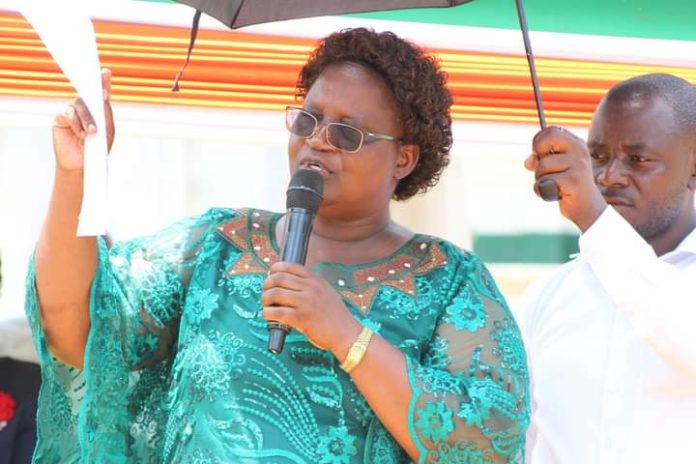
The Migori County Government has intensified its efforts to combat gender-based violence (GBV), femicide, and female genital mutilation (FGM) in the region, focusing on addressing the persistent challenges in the Kuria sub-counties. This commitment was announced during a press briefing by Prof. Rose Ogwang Odhiambo, the Chief Officer for Gender and Inclusivity, who reaffirmed the county’s resolve to eliminate these harmful practices.

Speaking at the event, Prof. Odhiambo commended President William Ruto’s leadership in addressing these issues. She praised the recent allocation of Ksh. 100 million for initiatives against GBV, femicide, and FGM as part of the national government’s 16 Days of Activism.

“These vices not only violate fundamental human rights but also undermine the foundation of our communities and the well-being of our people,” Prof. Odhiambo said.

The county government is enhancing collaborations with national institutions, law enforcement agencies, local leaders, civil society organisations, and the Judiciary to ensure robust prevention, response, and support systems are implemented.

In the Kuria sub-counties, FGM remains a particularly critical concern. Prof. Odhiambo emphasised that such harmful practices cause profound physical and psychological trauma to women and girls, stripping them of their dignity and potential.

“To our communities, we reiterate: femicide has no place in Kenya. FGM has no place in Kenya. These practices must end, and perpetrators must be held accountable,” she asserted.

The Chief Officer also raised concerns about the growing dangers posed by harmful interactions on social media platforms, urging parents and guardians to play an active role in guiding and protecting young people. She encouraged families to maintain open communication and remain vigilant about their children’s safety and well-being.

The Migori County Government has committed to implementing policies and programmes aimed at tackling these issues comprehensively. Prof. Odhiambo called on residents to unite to safeguard women, children, and other vulnerable groups.

“Let us come together as a society to protect our women, children, and vulnerable populations. Together, we can create a future where every person lives free from violence, discrimination, and fear,” she concluded.

This renewed dedication marks a significant step forward in Migori County’s campaign to eradicate GBV, femicide, and FGM, ensuring justice for victims and a safer, more equitable future for all.

Rise in Child sexual abuse and exploitation in Kisumu as City Manager want police to enforce ban on AirBnBs

0
Kisumu

By Anderson Ojwang

Kisumu is emerging as a hotspot for various forms of child sexual abuse and exploitation, with growing concerns about the escalating number of incidents.

Investigations by Western Insight Newspaper revealed that in Kisumu Central Sub-county alone, 86 cases have been reported this year, with the actual number of unreported cases believed to be significantly higher. Similar cases are also on the rise in other sub-counties across the county.

The investigation identified Lolwe, Milimani, Nyamasaria, and Dunga estates as hotspots for rampant child sexual exploitation. A section of prominent personalities, businesspeople, and politicians are alleged to be involved in these activities, reportedly using their wealth and influence to evade justice when such cases are reported to the authorities.

These estates have a high concentration of AirBnB facilities, which have been identified as sites where such crimes are committed, often going unnoticed and unpunished.

Acting Kisumu City Manager, Mr Abala Wanga, confirmed the prevalence of the vice, attributing its rise partly to unregulated AirBnB operations in the city. “I banned the business of AirBnBs and wanted them registered afresh. But the provincial administration is not helping much in cracking down on this vice. We must close, control, and regulate these AirBnB businesses to protect our children from sexual exploitation,” he said.

Mr Wanga expressed his commitment to tackling the issue and called on members of the public and the provincial administration to support efforts to curb the increasing child sexual exploitation associated with AirBnBs in Kisumu. He noted that many AirBnBs were being used by criminals as safe havens.

The investigation also revealed that both physical and online sexual abuse and exploitation of children are rampant in the city and on the rise.

Child protection organisations in the region disclosed that online child sexual live streaming has become a booming business in Kisumu, with perpetrators targeting vulnerable children using cheap inducements.

“Some of these people give their victims Sh2,000 for nude photos, while others are given freebies, phones, or taken on treats after exposing themselves in live-streamed shows beamed to potential clients in Europe and other parts of the world,” a source confided.

The organisations noted that the business is so lucrative that perpetrators often use children to recruit and groom others into the practice.

Most of the victims are from the slums of Obunga, Nyalenda, and Manyatta, as well as middle-class areas such as Migosi, Mamboleo, and Tom Mboya.

“When children come forward to complain, they are often blackmailed, which can lead to depression, suicidal thoughts, or withdrawal. The police demand hard evidence, and it’s becoming difficult to rely solely on the children’s word. This makes obtaining justice extremely challenging,” another source explained, requesting anonymity for security reasons.

The investigation also found that children’s homes and street children have become primary targets for sexual exploitation. In one case, a Kisumu businessman allegedly sexually exploits street children whom he employs in his premises.

“These children told us that after work, they watch pornographic content with their master on his laptop, and he then sexually abuses them. This has become a common routine,” revealed a source.

Additionally, some clubs in Kisumu have reportedly become dens for child sexual exploitation, a practice that appears to be growing.

Kisumu Deputy Governor Dr Mathews Owili condemned the situation and pledged action. “This is a sad situation that must be contained. We cannot allow this to go on unchecked. We are going to do something, definitely,” he said.

Elders want cultural centres built in Nyanza counties to preserve heritage

0
Cultural heritage

By reporter

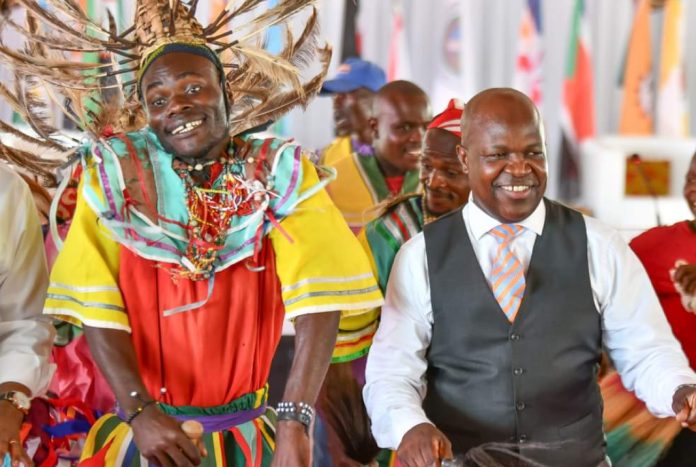
The Luo Council of Elders has called on Siaya, Kisumu, Homa Bay, and Migori counties to build cultural centres across Luo land, a significant step towards preserving and promoting the community’s rich heritage and traditions.

These centres will serve as crucial spaces for educating future generations about Luo customs, language, art, and history, ensuring that their cultural identity is maintained and celebrated despite modern influences.

According to Deputy Ker Luo, James Ayaga, these centres will perform several key functions as determined by the Elders’ Council.

“We want cultural education centres offering programmes and workshops on Luo history, music, dance, crafts, and oral traditions,” Ayaga said.

He added that the centres would provide a platform for Luo artists to showcase their works and preserve traditional art forms.

“We envisage promoting the use of the Luo language through language classes, storytelling sessions, and literature,” Ayaga stated.

Ayaga was speaking at West Uyoma Ward, where he hosted Kisumu Deputy Governor Mathews Owili to plan the Piny Luo Cultural Festival, scheduled for the end of this year at the Got Ramogi Cultural Shrine in Siaya County.

The elders noted that these centres would also facilitate tourism and cultural exchange programmes.

Ayaga explained that they aim for the centres to become destinations for tourists interested in learning about the Luo culture while fostering cultural exchanges with other communities.

Owili agreed, stating that by centralising efforts in each county, these cultural centres could promote a deeper sense of pride and unity within the Luo community while also contributing to the broader national cultural landscape.

The project, he added, would create opportunities for local employment and foster collaboration with cultural institutions and educational bodies.

Owili said, “We are organising, and plans are at an advanced stage, to host the Piny Luo Cultural Festival at the end of this year.”

All Luos from East Africa are invited to the event, which will also be attended by governors, MPs, senators, and MCAs. The festival, to be graced by cultural patron Raila Odinga, will run for three days from 30 December 2024 to 1 January 2025.

The County Government of Homa Bay launches its service charter to enhance service delivery

0
Homa Bay launches its service charter

By Reporter

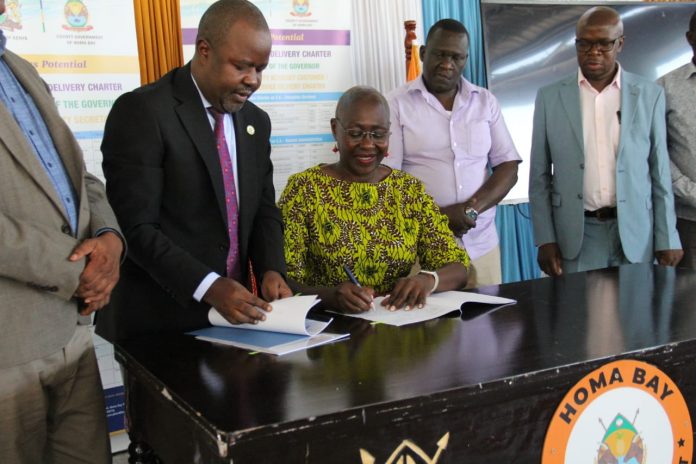
The Homa Bay County Government has launched its service charter with the aim of improving governance and enhancing the delivery of services to residents.

The County Executive Member for Governance and Devolution, Mercy Osewe, stated that the charter represents the county’s new commitments to the people of Homa Bay.

During the launch, the Homa Bay Government, through Osewe, signed a Memorandum of Understanding (MoU) with residents, facilitated by the Uraia Trust organisation.

Osewe emphasised the county government’s commitment to delivering services with efficiency, transparency, and accountability. She explained that the charter establishes measurable standards to guarantee effective and timely service delivery.

The charter includes a Public Participation component, where the county government has pledged to promote and facilitate citizen engagement in county activities and governance processes.

The Access to Information section of the charter outlines a framework to strengthen citizens’ access to information, thereby increasing transparency and awareness of county activities.

Other agreements under the signed MoUs include Policy and Legislative Development, Social Accountability, Knowledge Sharing, Technical Support, and Linking Civil Society with Government, among others.

Osewe highlighted that the charter would amplify citizens’ participation by embedding their priorities into county policies and programmes. “Homa Bay Government has now laid a foundation for a governance framework where people are both the centre and the drivers of development. We have formalised our partnership with Uraia Trust to strengthen our social accountability,” Osewe said.

Speaking during the MoU signing in Homa Bay Town, Osewe stressed that the collaboration was not only about adopting best practices but also creating a meaningful platform where residents can contribute to decision-making processes.

Present at the event were County Secretary Bernard Muok, Uraia Trust Director Oliver Waindi, and County Attorney Frederick Orego.

“My department will champion the implementation of the charter and foster a culture of accountability across all levels of government. Monitoring and evaluation will remain our key priority to ensure delivery on promises and to achieve the desired impact,” Osewe added.

Waindi encouraged Homa Bay residents to use the charter as a tool for engagement, advocacy, and collaboration, holding the county government accountable.

The director urged residents to focus on public participation, stating, “It is the only way we can build a responsive, efficient, and inclusive society.”

“We all have a role to play to realise a shared vision for Homa Bay County. We must uphold the principles outlined in the charter to build a county that delivers on its promises to its people,” Waindi said.

Muok described the launch of the charter as a milestone that defines what the residents expect from their county government.

“The launch of the service delivery charter demonstrates a transparent path in governance that the Homa Bay Government has decided to take. The charter makes Homa Bay a unique county because it allows both residents and the government to track projects delivered. We will know what has been achieved and what remains outstanding within a specified period of time,” Muok explained.